
| Attribute | Detail |
|---|---|
| Primary crash title | Aviator |
| Other instant-win / crash-style titles | Present in lobby; names vary by feed |
| Round length we timed | Typically 3 to 12 seconds before a crash |
| Cashout options | Manual tap and auto-cashout at a set multiplier |
| Minimum stake we placed | ₹100 |
| Published house edge / RTP | Not disclosed |
| In-game promo advertised | Up to 700% with slots specials |
| Promo wagering and expiry | Not disclosed |
| Last verified | 27 August 2026 |
On this page8 sections
What are crash games on CroreBet?
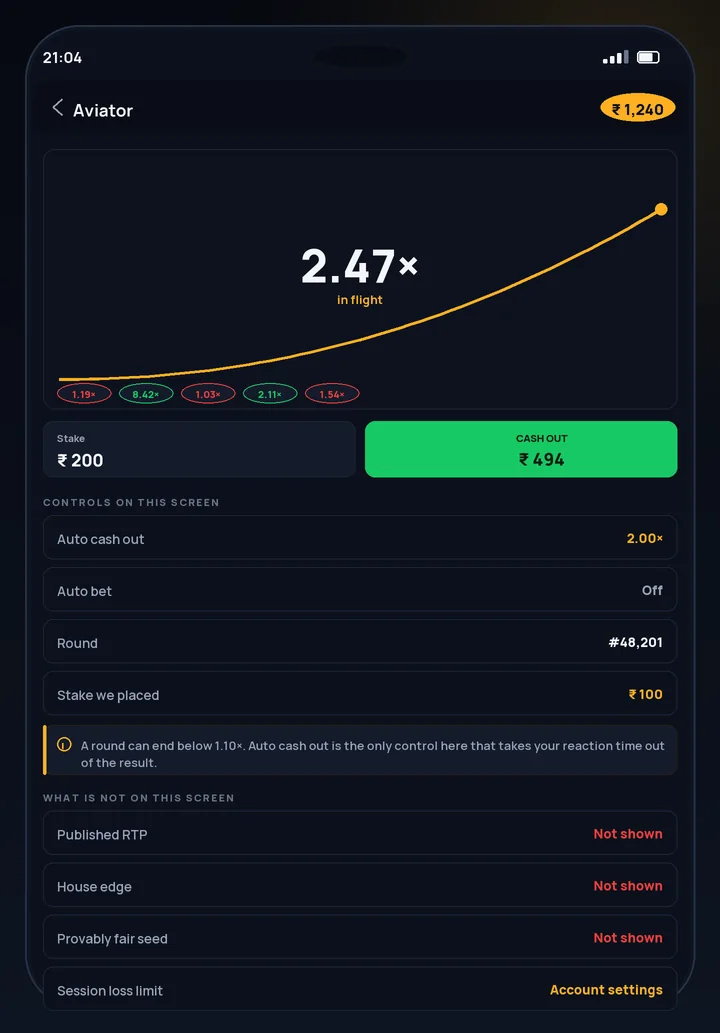
Crash games are rounds measured in seconds. Aviator is the title CroreBet puts on the home screen: a plane, a rising multiplier, a cashout button. You win only if you tap out before the round ends. There is no dealer, no cards, no innings to watch on a second screen.
That simplicity is why crash sits beside live Andar Bahar in the same app but behaves like a different product entirely. Live tables give you minutes between decisions. Aviator gives you seconds. The wallet is shared; the pace is not.
How does the multiplier actually pay?
Return equals stake times the multiplier at the moment you cash out. A ₹200 stake at 1.80× returns ₹360 total. Hold for 10× you never reach and the stake is gone. The math is trivial; the discipline is not.
| Cashout point | Return | Profit | What has to happen |
|---|---|---|---|
| 1.20× | ₹240 | ₹40 | Early tap; most rounds still crash higher |
| 1.80× | ₹360 | ₹160 | A common auto-cashout setting |
| 3.00× | ₹600 | ₹400 | Fewer rounds reach this point |
| 10.00× | ₹2,000 | ₹1,800 | Rare; waiting for it empties balances |
| Crashed first | ₹0 | ₹−200 | Any target set too late |
| Last verified | 27 August 2026 | ||
Early cashouts feel boring and are the only settings that resemble bankroll control. Waiting for a spectacular multiplier is entertainment priced as a bet. Our RTP and house-edge page explains why we will not paste supplier marketing percentages onto this operator.
Should you use auto-cashout?
Yes if you have already chosen the number, and no if you expect it to remove risk. Auto-cashout at 1.50× or 1.80× stops the "one more tick" habit. Auto-cashout at 10× is a delayed loss with extra suspense.
We ran a 40-round sample at ₹100 with auto-cashout set to 1.70× on 19 August 2026. The balance finished below the start even with a conservative target. That is one sample, not a forecast, and it is a reminder that a "safe" multiplier is still a negative-expectation product when the edge is unpublished.
Auto-cashout
Auto-cashout is a preset that sells your position the moment the multiplier reaches the number you chose. It removes tap timing but not house edge. It also removes the excuse of "I would have cashed" after a crash you watched too long.
What is the house edge on Aviator here?
Not disclosed. We searched the game frame, help links and operator pages on 19 August 2026 and found no published RTP or house-edge figure attached to this build. Supplier sites quote mid-90s RTP for Aviator on other operators; we will not copy those numbers here.
What do the 700% Aviator promos change?
We do not know in stable terms. Banners advertise in-game promos up to 700% on Aviator and slots. Headline percentage is not a payout. If bonus funds credit, assume wagering, game weighting and expiry exist even when they are not printed on a page we could archive.
Clear bonus status before you request an IMPS withdrawal. Compare in-game banners with the relatively documented 7× welcome package. A pending wagering bar is the usual silent hold reason.
Session tips that actually help
Nothing here beats a hidden edge. These habits only limit damage.
- Write a rupee loss cap before the first round, not a time cap you will extend.
- Set auto-cashout before you stake, not after you watch two crashes.
- Turn off auto-bet if your build offers it. Chained rounds without a pause is how ₹1,000 disappears in minutes.
- Do not switch to Aviator to "win back" a live-table session. Crash pace punishes chasing.
- Fund via UPI from your own account; keep KYC current so a test withdrawal is not your first document review.
Aviator versus live Indian tables
Choose by decision rate, not by which game "pays better" with hidden edges.
| Factor | Aviator | Live Andar Bahar |
|---|---|---|
| Time to resolution | Seconds | Under a minute per round |
| Information to reason about | Crash strip only | Visible cards and table rules |
| Decisions per hour | Dozens | A handful unless you add side bets |
| Data use on 4G | Moderate animation | Video stream — see stream quality page |
| Published edge | Not disclosed | Side bets not disclosed |
If you opened the app for Andar Bahar, stay on that table. Opening Aviator "for a minute" is the session that does not stay a minute. The dedicated Aviator page in the casino silo goes deeper on the same mechanics.
How fast can crash games empty a bankroll?
In minutes at ₹100 per round with immediate re-stake. Forty rounds at ten seconds each is under seven minutes of clock time, plus the pauses you skip when you are annoyed. That is not a flaw in the interface; it is the product.
Set deposit limits on the account before you open crash, not after the first losing streak. Read the legitimacy assessment if you are weighing whether to fund this lobby at all.
Pros and cons
What works
- Rules are obvious in one screenshot: stake, climb, cash out.
- Auto-cashout exists and is the only useful control on the screen.
- Loads faster than live dealer video on the same mid-range phone.
- ₹100 stakes were accepted in our August 2026 test.
- Same wallet as live tables and slots — no second account.
What does not
- No published RTP or house edge on this operator's Aviator build.
- In-game 700% promo terms are not in a stable public document.
- Session pace can empty a ₹1,000 balance in minutes.
- No information to reason about mid-round beyond the crash strip.
Verdict on Aviator and crash
Aviator on CroreBet is a short-loop crash game with unpublished edge and loud promos. Use it only with a rupee cap written down before the first round.
Skip it if you are clearing a welcome bonus without reading weighting, if you chase losses, or if you need published RTP before you stake.
Fine as a two-minute curiosity on leftover balance; unsuitable as a plan to grow a deposit.
| Criterion | Rating | Score |
|---|---|---|
| Rule clarity | 10/10 | |
| Player controls | 10/10 | |
| Edge transparency | 10/10 | |
| Promo honesty | 10/10 | |
| Bankroll safety by design | 10/10 | |
| Overall | 10.0/10 |
- 18+ only
- Offshore licence — see our check
- UPI deposits
- IMPS payouts
- ₹100 minimum
CroreBet Aviator and crash: common questions
How does CroreBet Aviator work?
Stake, multiplier rises from 1.00×, cash out before the round crashes. Return is stake times multiplier at cashout. Miss the window and the stake is lost.
Is there a winning Aviator strategy?
No strategy we would publish. Early auto-cashout reduces variance; it does not create positive expectation when edge is unpublished.
What is the minimum Aviator bet?
We placed ₹100 on 19 August 2026. Treat that as observed on that build, not a published casino-wide rule.
Crorebet aviator mein auto-cashout kaise set karein?
Round se pehle multiplier number choose karo, phir stake lagao. Baad mein badalna aam taur par loss chase jaisa lagta hai. 1.50× se 1.80× conservative range hai.
Does Aviator count toward welcome wagering?
Crash and slots usually count toward the 7× casino package, but weighting and max-bet rules are not published. Read the live offer or skip until the bar clears.
Aviator ya live Teen Patti — kya better?
Teen Patti slower hai, zyada cards dikhte hain. Aviator tez hai aur balance jaldi gir sakta hai. Pehli session ke liye live table safe starting point hai.
Want to check this against the live app?
Offers, odds and limits move week to week, so the app is always more current than any page about it. Setting up an account takes under three minutes, costs nothing, and the ₹100 minimum keeps a first test genuinely small.
- 18+ only
- Offshore licence — see our check
- UPI deposits
- IMPS payouts
- ₹100 minimum